5 Best Coolers for Fishing and Boats (October 2026)
The best coolers for fishing and boats include the RTIC 32 Ultra-Light for small-crew day trips, the RTIC 65 Ultra-Tough for longer fishing trips, and the Lifetime High Performance Cooler for large-crew outings.
On this page (9 sections)
- The best cooler for boat trips and fishing
- How we compared these boat coolers
- What should you measure before taking a cooler aboard?
- Which cooler size suits your crew and catch?
- How should you move and secure a loaded boat cooler?
- How should you pack ice, food and drinks for fishing?
- What care does a boat cooler need after each trip?
- Which mistakes make a boat cooler harder to use?
- Which cooler should you choose for a boat?
The RTIC 32 Ultra-Light is the best cooler for most boat day trips because its compact size and one-person carrying design make loading simpler. Choose the Igloo Marine Cooler for frequent wet, sunny outings, or move up to a larger chest when your crew, provisions or catch need more room.
The right boat cooler must fit 3 things: your load, your boat and the route between them. Extra storage helps only if you can lift the packed cooler aboard and secure it without blocking access.
For a broader look at cooler types, start with our guide to camping coolers explained. If you mainly need cold storage across several days, compare our coolers for ice retention before settling on a size.
Our picks at a glance
-
1

-
2

-
3

The best cooler for boat trips and fishing
The RTIC 32 Ultra-Light is the first choice for a modest day-trip load, while the larger picks suit crews with more supplies and a planned storage spot. The Igloo and Coleman add features aimed at marine use, with wheels setting the Coleman apart.
Best boat cooler for a small crew: RTIC 32 Ultra-Light
RTIC 32 Ultra-Light
- 32 qt capacity
- 14.7 lb empty weight
- Up to 48 cans
- Up to 2.5 in of closed-cell foam insulation
A compact hard cooler for boaters who carry their own supplies aboard. Choose it when a manageable load matters more than space for a large crew or catch.
Pros
- Designed for one-person carrying
- Smaller footprint than the larger RTIC
- Includes a drain plug
Cons
- Smallest capacity in this group
- Limited room for provisions and a catch together
Choose the RTIC 32 Ultra-Light when you usually carry lunch and drinks aboard yourself. Its 32 qt capacity and 14.7 lb empty weight make it easier to plan around than the larger RTIC, especially when loading involves a narrow dock or a short lift over the gunwale.
RTIC says it's more than 30% lighter than rotomolded coolers of the same capacity. It has up to 2.5 in of closed-cell foam insulation, with room for up to 48 cans or up to 30 lb of ice as separate capacity measures.
The exterior measures about 23.2 x 15.2 x 14.5 in. Mark that footprint on your intended storage spot, then check that the open lid won't hit a seat or prevent access to a compartment.
This is the sensible choice for short outings where every item must earn its space. Pack food in sealed containers and keep the day's drinks easy to reach so the compact interior stays useful.
Skip it if you need to carry a crew's provisions and keep a catch in the same chest. Moving up in size is better than filling a small cooler so tightly that you leave too little room for ice.
More room for provisions: RTIC 65 Ultra-Tough
RTIC 65 Ultra-Tough
- 65 qt capacity
- 34.4 lb empty weight
- Up to 84 cans
- Up to 2.4 in of closed-cell foam insulation
A rotomolded chest for boaters who need more provisions and can manage a heavier lift. Its freezer-style gasket and insulation suit trips where keeping supplies cold is a priority.
Pros
- More storage than the compact RTIC
- Rotomolded construction
- Freezer-style gasket
Cons
- Heavy before adding ice and supplies
- Wide exterior needs a clear storage spot
Choose the RTIC 65 Ultra-Tough for fishing trips that need more cold storage than a compact chest can provide. Its 65 qt capacity gives you space for a larger supply load, but the 34.4 lb empty weight calls for a lifting plan before you start packing.
The rotomolded body has up to 2.4 in of closed-cell foam insulation and a freezer-style gasket. RTIC claims up to 7 days of ice retention when its cooling tips are followed; plan your actual ice supply around heat, opening frequency and trip length.
Its exterior measures 31.58 x 17.64 x 16.66 in. That width matters if you need to pass it through a gate, tuck it between seats or leave a walking route beside it.
This cooler suits boaters who can load with help or keep the chest in a suitable fixed position during the outing. Organize supplies by meal or use so its extra depth doesn't turn every drink stop into a search.
Skip it for light solo trips where the cooler must be carried full several times. Read what a rotomolded cooler is if you're deciding how much construction matters for your trips.
Bulk storage for bigger boats: Lifetime High Performance Cooler
Lifetime High Performance Cooler
- 115 qt capacity
- 42.5 lb weight
- Divider doubles as a cutting board
- Garden hose compatible drain
The largest chest here suits boats with a planned place for bulk cold storage. Its divider helps organize the interior, while the hose-compatible drain helps direct meltwater during cleanup.
Pros
- Largest capacity in this group
- Included divider and cutting board
- Drain accepts a garden hose
Cons
- Heavy before loading
- Requires careful lifting and space planning
Choose the Lifetime High Performance Cooler when you have a clear need for bulk storage and a boat that can accommodate it. Its 115 qt capacity is the largest here, so it makes more sense for planned crew supplies or substantial catch storage than a casual lunch outing.
The cooler weighs 42.5 lb before loading. Decide who will lift it, where they'll stand and whether supplies can be added after the empty chest is safely aboard.
An included divider doubles as a cutting board, and the drain spout accepts a garden hose. The divider helps organize contents, but it doesn't replace sealed containers for keeping raw food or fish separate from ready-to-eat items.
Lifetime claims up to 10-day ice retention. For a long trip, keep perishable food under temperature checks and have a plan to replenish ice rather than relying on that duration alone.
Skip this chest if you'll rarely use its volume or can't confirm its fit before ordering. Its main benefit is storage space, and that benefit disappears when the cooler blocks a hatch or makes moving around the boat awkward.
Marine details for regular outings: Igloo Marine Cooler
Igloo Marine Cooler

- 54 qt capacity
- UV inhibitors
- Hybrid stainless steel and plastic latch
- Rust-resistant lid strap and screws
A middle-size chest with hardware and handles aimed at sunny, wet conditions. Choose it for routine boating when you need more room than a compact cooler provides.
Pros
- Igloo says UV inhibitors help resist sun damage
- Comfort-grip handles designed for wet conditions
- Rust-resistant stainless steel lid hardware
Cons
- Less room than the larger fishing chests
- Swing-up handles need clearance for carrying
Choose the Igloo Marine Cooler for regular boating when a compact chest is too small but a large fishing cooler would be awkward. Its 54 qt capacity fits between those extremes, with features aimed at handling sun and wet conditions.
Igloo says its UV inhibitors help protect against sun damage. The comfort-grip swing-up handles are designed for wet use, while the hybrid latch combines stainless steel in the hinge area with plastic in the snap area.
Rust-resistant stainless steel also appears in the lid strap and screws. Those details make this a useful candidate for repeated marine outings, though salt should still be rinsed away after the trip.
The exterior measures 26.38 x 15.5 x 15.5 in. Leave clearance to raise the handles, grip them securely and open the lid without pulling the chest out of its storage position.
Skip it if wheels are essential to your shore route or your load regularly exceeds a middle-size cooler. Compare the best wheeled coolers if the walk from parking to the dock is your biggest carrying problem.
Rolling crew supplies to the dock: Coleman Marine Cooler
Coleman Marine Cooler
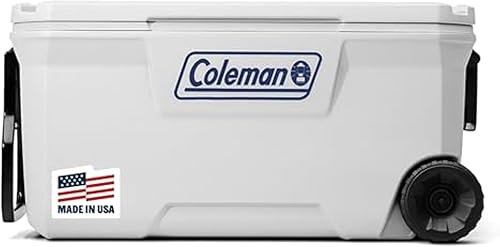
- 100 qt capacity
- Heavy-duty 6 in wheels
- Up to 160 cans
- UV coating and rust-resistant hardware
A large wheeled cooler for crews with a suitable rolling route from the vehicle to the boat. Plan the final lift aboard before filling it.
Pros
- Wheels and tow handle help with dock transport
- Insulated lid and body
- Channel drain plug for emptying meltwater
Cons
- Wheels don't solve steps or boarding gaps
- Large chest needs secure storage aboard
Choose the Coleman Marine Cooler when a long, suitable rolling route separates your vehicle from the boat. Its 100 qt capacity, 6 in wheels and tow handle suit moving a crew's supplies along a clear dock or paved approach.
Coleman claims its insulated lid and body keep ice for up to 5 days in temperatures as high as 90°F. The brand also says its UV coating helps protect against sun damage, and the cooler has rust-resistant stainless steel hardware.
The closed lid supports up to 250 lb, according to Coleman, and includes a ruler and cup holders with drains. Its channel drain plug lets you empty meltwater, but seating aboard still requires a stable, secure location.
Plan the final transfer before using all that storage room. A cooler that rolls easily to the dock can still be difficult to lift across a boarding gap once full.
Skip it if your route mainly involves steps or if the boat has little room for a large chest. Wheels solve the rolling portion of the journey; the boarding lift and storage footprint still need their own answers.
How we compared these boat coolers
We prioritized fit, loaded handling and useful storage because those factors decide whether a cooler works aboard. We also compared insulation, closures, drains and features intended for sunny or wet conditions.
The scores reflect those tradeoffs for boating. A large chest can offer more storage yet rank below a compact model because moving and positioning it takes more planning.
Ice-retention claims weren't treated as a direct contest between brands. Different conditions can change ice life, so a claimed duration is less useful than knowing how you'll pack, open and replenish the cooler.
What should you measure before taking a cooler aboard?
Measure the full route and the storage spot, including the space needed to use the cooler. A chest that fits on deck can still be the wrong choice if it won't pass through the entrance or open beneath a seat.
Check the narrowest point on the route
Measure gates, cabin doors, hatches and any passage the cooler must pass through. Allow room for your hands around the handles rather than comparing the opening with the cooler body alone.
Think about changes in height, too. A comfortable lift from the ground can become awkward when you must reach across a rail or step down into the boat.
Check access after it's in place
Leave space to open the lid, reach the drain and check the closure. If every meal requires dragging the cooler out of a tight bay, you'll spend more time moving it and leave it open longer.
Keep walking routes, controls and needed gear accessible. Before buying a large model, use an empty box or a marked outline to see how its position affects normal movement aboard.
For a flexible lunch-and-drinks option, compare the best soft coolers. A smaller separate bag can make more sense than enlarging the main hard cooler just to handle a few personal items.
Which cooler size suits your crew and catch?
Choose capacity around your actual packing list, with space for ice included. Crew size alone won't tell you enough because a short lunch outing and a full fishing day can require very different loads.
Count supplies before choosing capacity
List drinks, meals, snacks and any chilled ingredients you'll bring. Then decide whether the same cooler must also hold bait or a catch.
Can counts aren't ready-made packing plans. Food containers, bottle shapes and ice all change how much fits, and the advertised maximum doesn't describe a mixed load prepared for your trip.
A compact chest suits modest supplies that will be used within the day. Middle-size models make sense when several people share food and drinks, while large chests need a clear reason for the extra volume.
Give a catch its own plan
If keeping fish is part of the outing, leave cold storage available for the return trip. Don't fill all your space with drinks at departure and assume an empty corner will appear later.
A separate catch cooler can keep food organization simpler, but only if the boat has room for both. A divider helps arrange contents; sealed containers provide the separation needed for ready-to-eat food.
Use our guide to choosing the right cooler size if you're caught between a compact chest and a larger model. Choose from the packed load backward, rather than buying the biggest cooler that fits in your vehicle.
How should you move and secure a loaded boat cooler?
Plan the lift before packing, then secure the cooler in a suitable position before departure. Empty weight is only the starting point once ice, drinks and food go inside.
Make the boarding lift manageable
Check the route while the cooler is empty and arrange help for awkward transfers. Keep hands clear of pinch points, and avoid carrying a heavy chest while trying to step across a gap.
Where practical, place the empty cooler aboard first and add supplies at its storage position. Make sure that approach won't leave you carrying loose food or ice along an unsafe route.
For wheeled models, check dock joints, slopes and steps before filling the cooler. Keep control of the load near edges, and use help for transitions that can't be rolled.
Secure it for movement underway
Use a restraint method suited to your boat, its attachment points and the cooler. Don't assume the handles, lid hardware or drain are suitable tie-down points unless the cooler's instructions allow it.
Keep straps from interfering with steering, walking or access to safety gear. Check that the chest can't slide into another object or shift when the boat turns.
A cooler with a seating claim still needs a safe location. Don't use it as a boarding step or rely on it for balance while the boat is moving.
How should you pack ice, food and drinks for fishing?
Start cold, pack in order of use and leave enough room for ice. Good organization reduces lid openings and makes it easier to keep food separate from drinks, bait and fish.
Chill the cooler and supplies before departure
Cool a warm chest before adding the ice you'll take on the trip. Load food and drinks already chilled so your main ice supply doesn't have to cool warm contents.
Keep the cooler shaded where practical, with access to the lid and drain. Avoid leaving it in a hot vehicle while you finish other preparations.
Put frequently used items within reach
Place the first drinks and snacks near the top, with later meals below. Group food in sealed containers so you can remove what you need without rearranging the entire load.
If space allows, a separate drinks cooler can reduce openings of the food cooler. For a small boat, keeping a few drinks accessible in the main chest may be the better use of deck space.
Plan for food temperature and return-trip storage
Use a cooler thermometer for perishables and keep raw food sealed away from ready-to-eat items. Follow USDA guidance on keeping food safe outdoors when planning meals and handling leftovers.
Remaining ice doesn't tell you the temperature of every food container. Check the food-storage area and replenish ice when needed, especially after frequent openings or adding a catch.
Read our guide to keeping ice longer in a cooler for packing methods. Use how much ice to bring to build ice into the load before the interior fills with supplies.
What care does a boat cooler need after each trip?
Empty, rinse, wash and fully dry the cooler after use. Salt, fish residue and trapped moisture create more work when they're left until the next outing.
Remove containers and loose debris before washing. Use a mild cleaner suited to the cooler's care instructions, paying attention to the drain, lid edges and gasket where fitted.
Rinse salt from handles, hinges, latches and other exposed hardware. Rust-resistant parts still need care, and dried salt can collect around moving parts.
If the cooler has a cutting-board divider, clean it after food prep and before returning it to storage. Don't let fish residue transfer from the prep surface to drinks or food packaging.
Leave the lid open until the interior and drain area are dry. Follow our guide to cleaning a cooler and removing smells for a fuller cleaning routine.
Which mistakes make a boat cooler harder to use?
Buying around capacity alone causes the biggest problems. Check how the cooler will be carried, opened, cleaned and secured before adding more storage volume.
- Packing to the rim without enough ice: Reduce the supply load or choose more cold-storage space.
- Treating wheels as a complete transport plan: Arrange help for stairs, boarding gaps and the final lift.
- Choosing by the longest ice claim: Match packing and replenishment to your trip conditions.
- Blocking the drain or lid: Check working clearance before securing the chest.
- Mixing drinks with bait or an uncontained catch: Use separate storage or sealed containers suited to the contents.
Also avoid choosing a familiar brand before checking dimensions. If the YETI Tundra is on your shortlist, our YETI Tundra 45 review gives you another model to compare against your measured space and carrying needs.
Which cooler should you choose for a boat?
The best cooler for boat use is the smallest one that safely carries your planned load and fits a secure, accessible spot. Start with the transport problem, then choose the capacity and features that solve it.
Pick the RTIC 32 Ultra-Light for a modest day-trip load you expect to carry yourself. Choose the RTIC 65 Ultra-Tough for more provisions when you have room and help with the lift.
Choose the Igloo Marine Cooler for routine marine outings in a middle-size chest. Pick the Coleman Marine Cooler when a long rolling approach is the main obstacle, or the Lifetime High Performance Cooler when bulk storage is essential.
Before ordering, write down the boarding opening, storage footprint and lifting plan. Then plan your ice supply with our guide to ice retention and trip length so the cooler arrives ready for the outing you actually take.
Our top 3 picks at a glance
-
1
-
2
-
3
Frequently asked questions
What size cooler works for a boat?
Choose the smallest cooler that holds your planned food, drinks and ice with room for any catch. A compact chest suits light day-trip loads; a larger crew needs more storage.
Measure the boarding route and storage spot, including lid clearance, before choosing by capacity alone.
Are marine coolers different from regular coolers?
Marine coolers often add features for sun, moisture and frequent handling. The Igloo Marine Cooler includes UV inhibitors, wet-condition grip handles and rust-resistant lid hardware.
These details help guide the choice for regular boating, but you still need to rinse away salt, dry the cooler and secure it aboard.
Should I choose a wheeled cooler for a boat?
Choose wheels when the longest part of your route is a firm, clear walk to the dock. They help less at stairs, boarding gaps and narrow passages.
The Coleman Marine Cooler suits rolling a large load, provided you have a workable lifting plan and enough storage space aboard.
How can I keep ice longer on a fishing trip?
Pre-chill the cooler, load cold supplies and keep the lid closed between uses. Pack items in the order you'll need them so you aren't searching through the ice.
Our guide to how long ice lasts in a cooler explains why trip conditions matter more than a headline duration.