6 Best Cooler With Wheels (October 2026)
The best best wheeled coolers include the Coleman Xtreme Rolling Cooler for everyday group trips, the YETI Roadie 32 Wheeled for boat outings, and the Coleman Classic Wheeled Cooler for large gatherings.
On this page (10 sections)
- How we chose the best cooler with wheels
- How the wheeled coolers compare
- Best wheeled coolers for different trips
- What should you check before buying a wheeled cooler?
- How much capacity do you need?
- Do wheeled coolers keep ice longer?
- How should you pack and set up a rolling cooler?
- Which common mistakes make wheeled coolers harder to use?
- How do you clean and store a wheeled cooler?
- Which wheeled cooler should you choose?
The Coleman Xtreme Rolling Cooler is the best cooler with wheels for most trips because it balances useful packing space with straightforward hauling and draining. Choose a larger chest only when your food, drinks and ice need the extra room.
Your route matters as much as your group size. A cooler that rolls from a driveway to a patio has a different job from one crossing loose sand or needing a lift over campground steps.
Our cooler guide to hard, wheeled and soft picks explains the main styles. For trips centered on sand, start with our best wheeled coolers for the beach.
Our picks at a glance
-
1

-
2
-
3

How we chose the best cooler with wheels
We favored a useful balance of load space, rolling features and handling over maximum capacity alone. We compared the supplied specifications for wheels, handles, empty weight, insulation and features that help during packing or cleanup.
The order reflects broad usefulness for this search. A lower-ranked cooler can still be the better choice for a specific route, such as a sandy walk where large wheels matter more than a lighter empty chest.
Cooling claims need context. Different packing methods, weather and lid-opening habits prevent a day count from serving as a reliable head-to-head comparison.
How the wheeled coolers compare
Start with capacity and the route from your vehicle, then compare features that solve a specific need. Cup holders help at a gathering, while carrying handles matter every time you lift the cooler.
| Product | Best for | Capacity | Can capacity | Wheels and handle | Our score |
|---|---|---|---|---|---|
| Coleman Xtreme Rolling Cooler | everyday group trips | 50 qt | Up to 84 cans | All-terrain wheels; retractable telescoping handle | 8.8 |
| YETI Roadie 32 Wheeled | boat outings | NeverFlat wheels; retractable Periscope handle | 8.5 | ||
| Coleman Classic Wheeled Cooler | large gatherings | 100 qt | Up to 167 cans without ice | 6-inch all-terrain wheels; tow and swing-up handles | 8.4 |
| Igloo Maxcold Glide 110 | group fishing trips | 110 qt | Up to 168 cans | Soft-ride wheels; telescoping handle | 8.2 |
| RTIC 52 Ultra-Light Wheeled | organized camp meals | 52 qt | Up to 78 cans | Puncture-resistant all-terrain wheels; silicone-gripped aluminum handle | 8.0 |
| Igloo Trailmate Journey 70 | sandy picnic routes | 70 qt | Up to 112 cans | 10-inch never-flat wheels; locking telescoping Glide handle | 7.6 |
Can counts describe drink space under particular packing conditions. Use the table to narrow the field, then check whether your meal containers, ice and lifting plan fit the cooler you prefer.
Best wheeled coolers for different trips
Choose the Coleman Xtreme for general outings, then move to another model when its features solve a clear problem. The product sections below explain both the reason to buy each cooler and the reason to skip it.
1. Coleman Xtreme Rolling Cooler
Coleman Xtreme Rolling Cooler
- 50 qt capacity
- Holds up to 84 cans
- All-terrain wheels
- Retractable telescoping handle
A practical choice for picnics and campground trips when a large party cooler would take up too much room. The drain lets you empty meltwater without lifting or tipping the chest.
Pros
- 12.7 lb empty weight
- Retractable handle for storage
- Drain allows emptying without tipping
Cons
- Less packing room than the large group options
- Food and ice reduce space available for cans
The Coleman Xtreme suits a family picnic, campground weekend or shared drinks run where a huge chest would be awkward. Its 50 qt capacity gives it a middle-size role, and its 12.7 lb empty weight matters when you lift it into the car.
Coleman designs the all-terrain wheels for sand, gravel and grass. The telescoping handle retracts for storage, which helps keep a projecting handle out of your cargo area.
The drain is especially useful after an outing because you can release meltwater without tipping the whole load. Position that end toward an accessible edge when packing your vehicle or setting up camp.
Coleman claims ice retention of up to 5 days at temperatures up to 90°F. The brand also says the lid supports up to 250 lb as an extra seat.
Buy this if you want one cooler for several kinds of casual trips. Skip it if your usual load includes group meals, bulky containers and drinks that would force you to sacrifice ice space.
For occasional larger gatherings, a separate drinks container may be easier to manage than making every trip with an oversized chest.
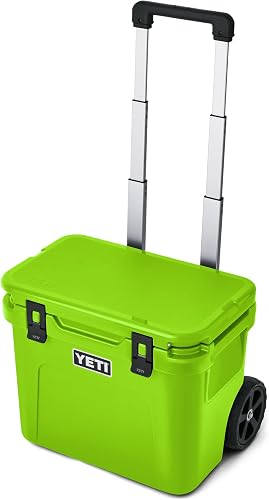
2. YETI Roadie 32 Wheeled
YETI Roadie 32 Wheeled
- Retractable Periscope handle
- Impact- and puncture-resistant NeverFlat wheels
- LipGrip carrying handles
- BearFoot non-slip feet
Choose the Roadie for trips that involve both rolling and carrying, with non-slip feet for placement on a boat. Its carrying handles stay out of the way between lifts.
Pros
- Solid, single-piece tires
- Separate carrying and pulling handles
- Non-slip feet help resist sliding
Cons
- Non-slip feet don't replace secure tie-downs
- Hard shell needs dedicated storage space
The YETI Roadie suits buyers whose trips involve rolling, lifting and placing the cooler on a boat. Its Periscope pulling handle retracts, while the separate LipGrip handles stay out of the way between carries.
The NeverFlat wheels use solid, single-piece tires that YETI describes as impact- and puncture-resistant. That construction removes the need to maintain air pressure, though wheel design alone doesn't make every surface easy to cross.
YETI says the BearFoot non-slip feet help prevent sliding on a boat or in a backseat. They help with placement, but a cooler still needs suitable restraint during travel.
The hard shell uses rotomolded construction. Choose this model for its combination of handling features rather than assuming a particular cooling duration from the brand name.
Skip it if your main goal is a large shared food-and-drink station. Work out the packing space you need first, especially if tall containers or several meals must fit alongside ice.
Don't treat the model number as a packing plan. Our YETI cooler sizes guide can help you compare models before settling on one.
3. Coleman Classic Wheeled Cooler
Coleman Classic Wheeled Cooler
- 100 qt capacity
- Fits 80 cans with 50 lb of ice
- 6-inch all-terrain wheels
- Four molded cup holders
A group drinks cooler for tailgates and campsite gatherings where it can stay in one spot after unloading. Cup holders, a stain-resistant liner and a tethered drain plug suit that role.
Pros
- Clear capacity example that includes ice
- Cup holders fit tumblers up to 30 oz
- Tethered plug stays attached during draining
Cons
- Long body needs substantial cargo space
- A full load requires planning for lifting
The Coleman Classic is the choice for a large gathering with a short hauling route. Its 100 qt body makes more sense as a shared campsite or tailgate station than as a lightly packed cooler for two people.
Coleman's capacity example is useful: it holds 80 cans with 50 lb of ice, compared with up to 167 cans without ice. That difference shows why the biggest can figure shouldn't drive your choice.
The 6-inch all-terrain wheels pair with tow and swing-up handles. At 36.9 inches along its longest stated dimension, the body deserves a careful cargo-space check before you order.
Four molded cup holders fit drinks and tumblers up to 30 oz. Coleman says the lid supports up to 250 lb, and claims ice retention of up to 5 days at temperatures up to 90°F.
A stain-resistant liner and tethered drain plug simplify end-of-trip cleanup. Leave the drain reachable so you don't have to reposition a heavy chest just to empty it.
Skip this model if you regularly face stairs or load the vehicle alone. For a closer brand comparison, read our Coleman vs Igloo guide.
4. Igloo Maxcold Glide 110
Igloo Maxcold Glide 110

- 110 qt capacity
- Holds up to 168 cans
- Lid ruler for measuring fish
- Telescoping handle and soft-ride wheels
The largest chest here by stated quart capacity suits group fishing trips and bulky supplies. A lid ruler, DuraLatch closures and stainless steel hinges add useful fishing-trip features.
Pros
- Room for bulky group loads
- Insulation in the body and lid
- Lid ruler provides a measuring surface
Cons
- 25.4 lb before adding contents
- Large footprint limits placement options
The Igloo Maxcold Glide is the large-load choice for group fishing trips. Its 110 qt capacity offers space for bulky supplies, while the lid ruler gives you a place to measure your catch.
THERMECOOL insulation runs through the body and lid. Igloo says UV inhibitors and infrared technology help protect against sun damage, though shaded placement remains a sensible habit for any cooler.
DuraLatch closures and stainless steel hinges are useful features to weigh if lid hardware is a priority. The telescoping handle and soft-ride wheels provide the rolling setup for moving the chest.
The main compromise is size. Its 25.4 lb empty weight comes before any food, drinks or ice, so plan the lift into your vehicle as carefully as the walk afterward.
Choose it when a large chest solves a regular packing need. Skip it for small outings where the extra footprint would crowd out chairs, bags or other gear.
If you'll carry fish and ready-to-eat food on the same trip, keep them separated in suitable sealed containers. See our Igloo Maxcold Glide review for a closer look at this model.
5. RTIC 52 Ultra-Light Wheeled
RTIC 52 Ultra-Light Wheeled

- 52 qt capacity
- Up to 78 cans
- Puncture-resistant all-terrain wheels
- Built-in silicone lid cargo net
A middle-size choice for campers who want a place for small items inside the lid. Its cargo net and no-slam pulling handle address organization and handling rather than maximum drink capacity.
Pros
- Lid net keeps suitable small items together
- Silicone grip on the aluminum handle
- 2.5 in of closed-cell foam insulation
Cons
- Lower stated can count than the Coleman Xtreme
- Ultra-Light is a relative weight claim
The RTIC suits campers who want middle-size capacity and better small-item organization. Its 52 qt body includes a silicone cargo net inside the lid, giving suitable small items a place apart from the main load.
Use that net for items that fit securely and won't prevent the lid from closing. Anything that must stay dry still needs a sealed container or bag.
The pulling setup combines puncture-resistant all-terrain wheels with a silicone-gripped aluminum handle and a no-slam design. Those are the reasons to compare it closely with other middle-size options.
RTIC says its 2.5 in of closed-cell foam insulation helps keep contents cold for multiple days. The brand's claim of being over 30% lighter than comparable same-capacity rotomolded coolers is a relative comparison.
Ultra-Light doesn't mean lightest in this group. Choose it for the hauling features and lid storage, then make sure you can manage the complete load.
Skip it if you mainly want maximum drink space for gatherings. Its stated can capacity is lower than the Coleman Xtreme's, and neither can figure tells you how your meal containers will fit.
6. Igloo Trailmate Journey 70
Igloo Trailmate Journey 70

- 70 qt capacity
- Fits up to 112 cans
- 10-inch never-flat wheels
- Removable butler tray
Large wheels and ground clearance make this the option to consider for sandy routes. The removable tray adds a serving surface once you reach your picnic spot.
Pros
- Large wheels designed for challenging ground
- Locking, telescoping steel handle
- Serving tray stores under the lid
Cons
- 34.7 lb empty weight
- Bulky body needs vehicle and storage planning
The Igloo Trailmate suits sandy picnic routes where wheel size deserves priority. Its 10-inch never-flat wheels and ground clearance are the clearest reasons to choose it over a simpler rolling chest.
The steel Glide handle locks and telescopes. Igloo designs the wheel-and-handle setup for challenging ground, but deep sand can still demand effort when the cooler is fully packed.
Once you arrive, the removable butler tray provides a serving surface on the handle. Remove drinks and food before moving the cooler, then store the tray under the lid.
Its 70 qt capacity sits between the middle-size coolers and the largest group chests. Igloo says Cool Riser Technology helps cooling by keeping the body away from hot surfaces.
The compromise is a 34.7 lb empty weight and a bulky shape. Skip this model if narrow storage space, frequent stairs or solo lifting will be a bigger part of your routine than sandy walks.
Choose it when the route and serving tray justify that bulk. For another large Igloo option, see our Maxcold Glide review.
What should you check before buying a wheeled cooler?
Check the whole trip from storage to your picnic spot, including every lift. Wheels help during the rolling portion, but they don't solve a high vehicle sill, narrow doorway or flight of stairs.
Match the wheels to the hardest part of the route
Buy for the most demanding stretch you'll cross regularly. A paved path followed by a long walk through loose sand calls for different priorities than an all-paved parking lot.
Larger wheels can help with uneven ground, while clearance helps the body avoid scraping. Soft sand still lets wheels sink, so reducing unnecessary cargo can matter as much as wheel design.
Check pulling comfort and lifting access
A pulling handle should let you walk without repeatedly hitting the cooler with your heels. Your height, stride and the cooler's pulling angle all affect comfort.
Before loading, check that retractable handles extend and lock as intended. Use carrying handles for lifting rather than assuming the pulling handle is designed to support the cooler's full weight.
Measure more than the cargo floor
Measure the vehicle opening, available floor area and overhead space. A cooler may fit on the floor yet be awkward to lift through the opening or impossible to open under a low shelf.
Allow room to reach the drain and carrying handles. Also think about where the cooler will live between trips, since a hard chest keeps its full shape in storage.
How much capacity do you need?
Choose capacity from an actual food, drink and ice plan. Group size helps, but meal containers, trip length and access to ice refills determine how much space you'll use.
Start by setting out the items you expect to pack. Count drinks separately from meals, then account for sealed containers, frozen items and the ice needed to surround the load.
Leave room for cooling, not just contents
A cooler packed wall-to-wall with drinks leaves little space for ice. Food that starts warm also adds a cooling job, so chill it before packing whenever possible.
For a more tailored estimate, use our guide to how many cans fit in a cooler. Our cooler size guide helps when you're still choosing a general capacity.
Decide whether one large cooler is the easiest option
One large chest keeps supplies together, but splitting food and drinks can reduce repeated openings of the food cooler. It also creates smaller loads for lifting.
The trade-off is managing two containers and finding room for both. Choose the arrangement that fits your vehicle and the people available to carry it.
Do wheeled coolers keep ice longer?
Wheels don't determine ice life. Insulation, starting temperature, shade, ice supply and lid openings have more direct effects on how long the contents stay cold.
Don't choose between these models by comparing day claims as though the conditions were identical. A cooler used for frequent drinks access has a different job from one kept closed with chilled meals inside.
For longer trips, plan where you can replace ice before you need it. Use a cooler thermometer for perishable food rather than treating the presence of a few remaining ice pieces as proof that everything is cold enough.
Our guide to keeping ice longer in a cooler explains the packing and use habits that help reduce avoidable melt.
How should you pack and set up a rolling cooler?
Chill the contents first, pack for access and check the drain before loading. Those steps prevent warm supplies, spills and repeated rummaging from making the cooler harder to use.
Prepare before departure
Clean and dry the inside, then make sure the drain plug is seated. Check wheels, carrying handles and the pulling handle for damage or obstructions before adding weight.
If possible, pre-chill the interior with ice, then replace that ice as you pack. Starting with a hot cooler uses part of your fresh ice supply to cool the chest itself.
Pack in the order you'll need things
Put later meals lower down and early-use items within easy reach. Keep raw ingredients in leakproof containers and separate them from ready-to-eat food.
Spread heavy items across the base rather than piling them at one end. Fill spaces around containers with ice, and use our guide to how much ice you need for a cooler to plan the cooling load.
Set up where access is easy
Choose a shaded, stable spot with room to open the lid fully. Keep the cooler out of busy walkways and retract a projecting handle when you no longer need it.
Leave drainage access clear, and keep food from sitting loose in meltwater. Bring separate chairs when needed rather than assuming every cooler lid is suitable for sitting.
Which common mistakes make wheeled coolers harder to use?
The biggest mistakes are overloading, overlooking lifts and packing without an access plan. They can turn a useful rolling cooler into an awkward load before you reach your destination.
- Buying for the rare biggest trip: Choose around your normal outings unless the larger cooler has a clear, regular job.
- Packing before planning the lift: If practical, position the empty cooler first and load it where it will travel.
- Pulling straight at curbs or steps: Stop and arrange a safe lift instead of forcing the wheels into an obstacle.
- Treating non-slip feet as restraints: Secure the cooler during transport so braking, turns or boat movement don't shift it.
- Burying every drink: Keep frequent-use items reachable so the lid spends less time open.
- Using a serving tray while rolling: Clear and stow removable serving parts before moving the cooler.
On slopes, keep control of the load and avoid routes where the cooler could pull you off balance. If the trip regularly includes difficult lifts, reduce the load or arrange help before leaving.
How do you clean and store a wheeled cooler?
Empty, wash and dry the cooler after each outing. Leaving food residue or dampness inside a closed chest creates avoidable odor and cleanup problems.
Use mild soap, water and a soft cloth or sponge, following the cooler's care instructions. Clean around the drain opening and plug, where residue can remain after the main chamber looks clean.
Rinse dirt or sand from the wheels and handle areas. Avoid forcing a gritty telescoping handle, and let parts dry before retracting them for storage.
Store the cooler with the lid open or ajar until the interior is completely dry. For stubborn smells or visible mold, follow our guide to cleaning a cooler and removing odors.
Which wheeled cooler should you choose?
Choose the best cooler with wheels by eliminating models you can't comfortably transport, then matching the remaining options to your usual load. A special feature earns its space only if you'll use it.
- Coleman Xtreme: Choose it for everyday outings when a middle-size cooler covers your food, drinks and ice.
- YETI Roadie 32: Choose it when separate carrying handles, solid wheels and non-slip placement features suit your trips.
- Coleman Classic: Choose it for shared drinks and large gatherings with a manageable route from the vehicle.
- Igloo Maxcold Glide 110: Choose it for bulky group supplies and fishing trips where the lid ruler has a purpose.
- RTIC 52 Ultra-Light: Choose it when the lid cargo net and pulling-handle design solve your camp-packing needs.
- Igloo Trailmate Journey 70: Choose it when sandy ground and a useful serving tray justify the heavier, bulkier chest.
Before ordering, confirm three things: where it will fit, how you'll lift it and what you'll pack alongside ice. If sand is the deciding factor, continue to our beach wheeled cooler guide.
Our top 3 picks at a glance
-
1
-
2
-
3
Frequently asked questions
What size wheeled cooler should I get?
Choose the smallest cooler that holds your food, drinks and planned ice supply. Start with the 50 to 52 qt options for smaller loads, then consider larger chests for group meals or shared drinks.
Count actual containers and leave room for ice instead of choosing from can capacity alone.
Are wheeled coolers good for the beach?
Wheeled coolers help on beach routes, but loose sand still takes effort to cross. Larger wheels and ground clearance deserve priority if the walk includes deep sand rather than mostly boardwalk.
Keep the load manageable and compare our best wheeled coolers for the beach before choosing.
How long can a wheeled cooler keep ice?
Ice life depends on insulation, starting temperature, weather, packing and how often you open the lid. Coleman claims up to 5 days for the Xtreme and Classic at temperatures up to 90°F.
Plan refill options for longer trips and read how long ice lasts in a cooler for the factors involved.
Are larger wheeled coolers harder to move?
Larger coolers become harder to move when you fill their extra space with food, drinks and ice. Wheels help on suitable ground, but you still need to lift the chest into a vehicle or over steps.
Check the route, cargo opening and available lifting help before choosing a large model.