5 Best Rotomolded Coolers (October 2026)
The best rotomolded coolers include the YETI Tundra 45 for mixed outdoor trips, the RTIC 32 Ultra-Light for solo day outings, and the YETI Roadie 24 for car-based day trips.
On this page (9 sections)
- Which best rotomolded cooler pick fits your trip?
- Why these cooler features matter more than rank alone
- How do you choose the right capacity without overbuying?
- How should you check carrying weight and vehicle fit?
- Does rotomolded construction guarantee longer ice life?
- How should you prepare and pack a rotomolded cooler?
- Which cooler mistakes waste space and effort?
- How do you clean and store a hard cooler?
- Which best rotomolded cooler should you choose?
The YETI Tundra 45 is the best rotomolded cooler for most trips because its basket, tie-down slots and gasketed drain solve common travel and campsite needs. Choose the RTIC 65 Ultra-Tough for group supplies or the YETI Roadie 24 for a narrower road-trip shape.
This comparison includes 3 rotomolded coolers and 2 lighter hard cooler alternatives. Start with what a rotomolded cooler is if you're still deciding whether that construction belongs on your must-have list.
Our picks at a glance
-
1

-
2

-
3

Which best rotomolded cooler pick fits your trip?
Choose the Tundra 45 for varied outdoor trips, the Roadie 24 for car stops and the RTIC 65 Ultra-Tough for shared camp supplies. The Ultra-Light options suit buyers whose main problem is moving the cooler.
The useful distinction is where the cooler will spend its time and how it gets there. A chest that stays beside your vehicle asks much less of you than one carried down steps, across a parking area and back again.
YETI Tundra 45
- 26 cans at a 2:1 ice-to-contents ratio
- Dry goods basket
- Tie-down slots
- Up to 3 in of insulation
Choose this cooler for trips that mix driving, camping and time on the water. The basket separates snacks from meltwater, while tie-down slots help secure the cooler during travel.
Pros
- Basket keeps snacks above meltwater
- Tie-down slots accept straps or rope
- Gasketed drain plug allows draining without tipping
Cons
- Bottles must fit the 10.7 in interior height
- Ice-inclusive capacity needs careful meal planning
The YETI Tundra 45 suits weekend campers and boat-day buyers who want one cooler for several jobs. Its included dry goods basket gives snacks a separate place, while molded tie-down slots accept straps or rope for travel.
Its capacity is 26 cans at a 2:1 ice-to-contents ratio, compared with 54 cans without ice. Use the first figure for cold-drink planning, then reduce the drink load if you're also packing meals.
The interior measures 18.3 x 9.4 x 10.7 in, so bottle height and food-container width deserve a check. A wide lunch container can waste useful space if it forces everything else into awkward gaps.
Up to 3 in of PermaFrost insulation and a freezer-style rubber gasket form its cooling setup. The gasketed Vortex drain lets you empty meltwater without tipping the chest, which helps when you've already chosen its camp position.
Buy it when organized storage and secure transport matter more than getting the largest possible interior. It's the strongest all-around match here for buyers who divide their time between camping, fishing stops and tailgates.
Skip it if your usual load is only lunch and a few drinks carried far from the car. Group meal supplies may also push you toward the larger RTIC rather than squeezing food into the basket area.
RTIC 32 Ultra-Light
- 32 qt capacity
- 14.7 lb empty weight
- Up to 48-can capacity
- Up to 2.5 in of insulation
A lighter hard cooler alternative for smaller outings where one person handles loading and carrying. Choose it for manageable starting weight rather than a rotomolded shell.
Pros
- 14.7 lb empty weight reduces the starting load
- Smaller capacity suits short outings
- Closed-cell foam insulation
Cons
- Not a rotomolded choice
- Maximum can capacity leaves ice allowance unclear
The RTIC 32 Ultra-Light suits short outings where one person handles the cooler from start to finish. This is a lighter hard cooler alternative, so choose another model if rotomolded construction is a firm requirement.
It weighs 14.7 lb empty and has a 32 qt capacity. RTIC says it's more than 30% lighter than rotomolded coolers of the same capacity, which makes reduced starting weight its main reason to buy.
The maximum capacity is up to 48 cans, but that figure doesn't establish a food-and-ice packing plan. Treat it as a storage limit and leave room for the cold source your outing needs.
The exterior is about 23.2 x 15.2 x 14.5 in, with an interior measuring 17.5 x 11 x 9.75 in. That interior height matters if you want to keep drink bottles upright.
Up to 2.5 in of closed-cell foam insulation supports its role as a hard cooler for picnics, car outings and smaller camping loads. Its lower empty weight leaves more of your lifting effort available for food and ice.
Buy it for modest loads and repeated solo lifts. Skip it for a shared camp pantry that needs substantial space for several meals, or if a rotomolded shell is the reason you're shopping.
YETI Roadie 24
- Rotomolded construction
- DoubleDuty shoulder strap
- LipGrip handles
- BearFoot non-slip feet
A rotomolded option for road trips where a tall cooler fits better than a wide chest. The shoulder strap and handles give you different ways to move it between stops.
Pros
- Shoulder strap offers another carrying option
- Handles stay out of the way
- Includes a Bestdam Drain Plug
Cons
- Tall shape needs lid-opening clearance
- Shoulder carrying still puts the full load on you
The YETI Roadie 24 is the rotomolded choice for buyers working around a narrow vehicle storage spot. Its tall shape and different carry options make more sense for road stops than a broad chest that uses up the floor.
This version includes a DoubleDuty shoulder strap, LipGrip handles and a Bestdam Drain Plug. Choose between the strap and handles based on the distance and the lift, rather than assuming one method will suit every stop.
The exterior measures 16.6 x 14.1 x 17.4 in across width, depth and height. Check both the closed height and the room above it, because a cooler that fits under luggage may still be awkward to open.
BearFoot non-slip feet are designed to reduce sliding. They don't replace securing a cooler during travel, especially when braking or turning can shift cargo.
YETI describes this rotomolded design as thinner and lighter for easier transport. That makes its shape and carrying setup the key reasons to consider it, without needing to assume a specific loaded carrying weight.
Buy it when the vehicle fit is right and you want rotomolded construction for a smaller outing. Skip it if a shoulder load bothers you or your routine calls for a wide, easily arranged spread of food containers.
For a wider view of the range, our YETI cooler sizes guide explains how to compare shapes before choosing.
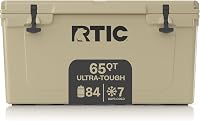
RTIC 65 Ultra-Tough

- 65 qt capacity
- Up to 84-can capacity
- Up to 2.4 in of insulation
- 34.4 lb empty weight
Choose this larger cooler for shared meals and drinks when it can stay near the vehicle or campsite. Plan the lift before filling it, since the empty shell already weighs 34.4 lb.
Pros
- Room for larger group supplies
- Freezer-style lid gasket
- Rotomolded shell
Cons
- Heavy before adding food and ice
- Wide exterior needs a planned storage spot
The RTIC 65 Ultra-Tough suits group camping when one cooler needs to hold shared meals and drinks. Its larger storage area is most useful when the cooler can stay near the vehicle or another easy unloading spot.
It offers 65 qt of capacity, with a maximum of up to 84 cans. Leave a separate allowance for ice and food packaging rather than turning that maximum into a promise about your weekend supplies.
The trade-off is 34.4 lb of empty weight before anything goes inside. Decide who will help lift it and where each person can stand before loading the chest.
Its exterior measures 31.58 x 17.64 x 16.66 in across width, depth and height. Check the trunk opening as well as the space inside, since a roomy cargo area can still have a tight entrance.
The rotomolded shell surrounds up to 2.4 in of closed-cell foam insulation and has a freezer-style gasket. RTIC claims up to 7 days of ice retention when its cooling tips are followed; plan access to replacement ice instead of treating that as a fixed allowance.
Buy it for shared supplies with a short carry. Skip it for solo outings with repeated unloading, and use our hard vs soft cooler guide if a smaller carry bag could cover those trips.
RTIC 52 Ultra-Light Wheeled

- 52 qt capacity
- All-terrain wheels
- Ergonomic aluminum handle
- Built-in lid cargo net
A wheeled alternative for larger loads traveling along a towable route. It suits tailgates and accessible campsites, provided you can handle the lift into your vehicle.
Pros
- Puncture-resistant all-terrain wheels
- Handle designed for one-person towing
- Lid cargo net separates smaller items
Cons
- Not a rotomolded choice
- Wheels don't remove vehicle-loading or stair lifts
The RTIC 52 Ultra-Light Wheeled suits larger loads traveling from a parking spot to a tailgate or accessible campsite. It's a hard cooler alternative for buyers who value towing more than rotomolded construction.
Its puncture-resistant all-terrain wheels work with a silicone-gripped aluminum handle designed for one-person towing. The handle also has a no-slam design, while a silicone cargo net inside the lid separates smaller items.
Capacity is 52 qt, with room for up to 78 cans under maximum-capacity packing conditions. Food containers and ice still need their own share of that space.
The cooler has 2.5 in of closed-cell foam insulation. RTIC says it is over 30% lighter than rotomolded coolers of the same capacity, but wheels remain its more useful distinction for a buyer moving a full load.
Walk through the route before choosing it. Steps, deep sand, narrow gates and a high vehicle cargo floor can turn part of a rolling trip into a carrying job.
Buy it when most of the route is towable and you have a workable loading plan. Skip it if stairs dominate the journey or you specifically want one of the rotomolded models in this comparison.
Why these cooler features matter more than rank alone
The right cooler solves your main trip constraint, so use the order as a starting point rather than a reason to accept the wrong shape or carrying method. JunkDrawerJoy compared construction, capacity, storage and transport features for these picks.
The Tundra leads because its storage and tie-down features apply to several common outdoor uses. A buyer loading alone may still be better served by the smaller Ultra-Light, while a group cook may need the larger Ultra-Tough.
Keep the distinction between the 3 rotomolded choices and the 2 Ultra-Light alternatives clear. If you're open to more carrying styles, our guide to hard, wheeled and soft camping coolers puts those options in context.
How do you choose the right capacity without overbuying?
Choose capacity from meals, drinks and ice together, then confirm that the packed cooler remains manageable. A maximum can count is a poor substitute for planning the food you'll actually bring.
How much room does the best rotomolded cooler need?
Start by laying out a typical trip's food containers and drinks, including the items needed on the final day. Separate anything that doesn't need chilling so it won't take up cold storage.
Next, allow room for ice around that load. Don't size the chest so tightly that keeping everything cold depends on a thin layer of cubes across the top.
The Tundra's ice-inclusive can figure is a useful reminder that cooling space can exceed drink space. Maximum counts for the other models shouldn't be compared directly with that ice-inclusive number.
For mixed loads, container shape often matters as much as total volume. Square containers can pack neatly together, while bulky tubs or tall bottles may force a different cooler shape.
Our guide to how many cans fit in a cooler explains why can counts and usable trip capacity aren't the same thing.
When is a larger chest worth carrying?
A larger chest makes sense when you routinely need the space and can leave it in one place. It becomes harder to justify when you carry mostly empty interior volume on short outings.
For a longer stay, plan meals that share ingredients and use containers matched to each portion. This can free space without asking the cooler to hold food more tightly than ice can reach.
A group may also prefer separate food and drink coolers if drinks are accessed all day. That arrangement reduces how often the food chest is opened, but it adds another item to load and store.
How should you check carrying weight and vehicle fit?
Check the full route and the loaded lift, including the return trip when you're tired. Empty weight is only the starting point; ice, drinks and food all add to the load.
Measure the opening, the parking spot and the lid space
Measure the vehicle opening before measuring the intended storage area. Include room to grip the cooler during loading rather than choosing a fit that leaves your hands squeezed against the trim.
At the destination, allow enough space to open the lid without moving nearby gear. A cooler wedged under a table or luggage stack encourages longer, more awkward openings.
Check doorways, stairs and the distance from parking as well. These details can make a lighter chest more useful than a larger rotomolded one.
Match the carrying method to the ground
A shoulder strap changes how you carry weight, but it doesn't reduce the load. Keep it close to your body and use the handles for controlled lifts through tight spaces.
Wheels reduce carrying on a suitable route, yet loose ground and steep changes in level still demand effort. Our guide to wheeled coolers for the beach focuses on the special demands of sandy access.
Plan a helper for a heavy chest before filling it. If loading requires twisting or reaching deep into a trunk, change the cooler position or unload some contents first.
Does rotomolded construction guarantee longer ice life?
Rotomolded construction describes the shell, while insulation, seals, packing and heat exposure determine how the cooler performs on your trip. Choose the build for your use, then judge the cooling setup separately.
Thick walls occupy space, so a large exterior doesn't always mean a generous food compartment. Compare interior measurements with your containers rather than assuming similar-looking coolers hold similar loads.
Day-based ice claims also depend on conditions. A chest opened repeatedly beside a sunny picnic table faces a different job from one kept shut in shade.
For remote trips, leave room in the plan for replacement ice and check the contents rather than relying on a claimed duration. Frozen food, loose cubes and chilled drinks won't all change temperature at the same rate.
Our rotomolded vs regular cooler comparison helps decide whether the shell construction is worth the carrying and storage trade-offs for your routine.
How should you prepare and pack a rotomolded cooler?
Pre-chill the cooler and its contents, then pack around enough ice for the outing. Starting with a warm shell and room-temperature drinks spends ice on cooling them down before it can maintain the load.
Prepare it before departure
Bring the empty cooler out of a hot shed or vehicle ahead of packing. Use spare ice to cool the interior, then remove that ice and meltwater before adding the trip supply.
Chill food and drinks in a refrigerator first. Freeze suitable foods ahead of time only if their packaging and texture can handle it.
Check that the drain plug is seated and the lid gasket is clean. A crumb or folded bag edge caught under the lid can stop it from closing properly.
Pack for access as well as cooling
Put later meals lower down and first-stop items near the top. Keep a simple meal order so you can find what you need without digging through the whole chest.
Use sealed containers for food that must stay dry. A basket separates items from pooled water, but it doesn't replace a watertight container for anything vulnerable to spills.
Keep raw meat or fish sealed and separate from ready-to-eat food. Pack heavy frozen items where they won't crush softer food as the load shifts.
Leave the lid easy to close without pressing down on packages. Overfilling can interfere with the seal and makes every stop take longer.
Choose a sensible camp position
Set the cooler on stable ground in shade when possible. Keep it close enough for convenient access without placing it where everyone will open it out of habit.
Secure it during vehicle travel using suitable attachment points and restraints. A non-slip base helps with movement but isn't a substitute for holding cargo in place.
Keep frequently requested drinks easy to reach. Agree on where things belong so several people don't search the same chest for a single bottle.
Which cooler mistakes waste space and effort?
Avoid buying for a maximum can count, choosing by exterior size alone or assuming wheels remove every lift. These mistakes usually become clear only after the cooler is packed.
Another common error is adding warm drinks throughout the day. Chill the next batch first when possible, or accept that cooling it will use some of the ice reserved for the existing load.
Don't open the lid and decide what to eat while it stays raised. Choose the meal first, gather the needed items and close the chest.
Avoid packing loose food in thin wrappers that can soak through or split. Reusable sealed containers help keep meltwater from turning one damaged package into a full cleanout.
Don't buy extra capacity solely for an occasional large gathering if most trips are small. Borrowing extra storage or using a second cooler for that rare outing may suit your routine better.
How do you clean and store a hard cooler?
Wash, rinse and fully dry the cooler after each trip, especially after raw food, fish or spilled drinks. Leaving residue in a closed chest gives smells a chance to linger.
Remove loose ice and debris, then hand wash the interior and removable parts with mild soap and water. Wipe the gasket folds and the area around the drain, where residue is easy to miss.
Rinse until no soap remains and dry the drain opening as well as the main compartment. Leave the lid open while the interior finishes air-drying.
Before storage, check that the gasket is clean and the drain plug is accounted for. Keep the lid slightly open in a suitable storage spot so trapped moisture can escape.
For stubborn odors or visible growth, follow our cooler cleaning and odor-removal guide before packing food again.
Which best rotomolded cooler should you choose?
Choose the best rotomolded cooler for the trip you repeat most often. Match the load first, confirm the vehicle fit, then decide whether you can comfortably handle every lift.
- Choose the YETI Tundra 45 for a mix of camping, fishing stops and tailgates where its basket and tie-down options earn their space.
- Choose the RTIC 32 Ultra-Light for smaller solo outings when lower starting weight matters more than rotomolded construction.
- Choose the YETI Roadie 24 when a tall, narrower shape fits your vehicle and the shoulder strap suits your stops.
- Choose the RTIC 65 Ultra-Tough for group provisions when you have lifting help and a nearby unloading spot.
- Choose the RTIC 52 Ultra-Light Wheeled for larger loads moving along a towable route, with a plan for vehicle loading.
If several models still fit, choose the smallest one that holds your real meal plan plus cooling ice. For trips where ice life is the deciding factor, compare our coolers for ice retention next.
Our top 3 picks at a glance
-
1
-
2
-
3
Frequently asked questions
What is a rotomolded cooler?
A rotomolded cooler has a plastic shell formed in a rotating mold. The YETI Tundra 45, YETI Roadie 24 and RTIC 65 Ultra-Tough use this construction.
Our guide to what a rotomolded cooler is explains the process and the practical differences between these shells and other hard cooler designs.
Are rotomolded coolers worth the extra weight?
Rotomolded coolers make sense for repeated outdoor use when you can manage the loaded weight and have room for the shell. A lighter design is easier to justify for frequent solo carrying.
Use our rotomolded vs regular cooler comparison to weigh the construction choice against your actual trips.
How big a rotomolded cooler should I get?
Choose enough interior space for your trip's food, drinks and cooling ice, then check that the exterior fits your vehicle. Start with a meal plan rather than a maximum can count.
Our guide to what size cooler you need helps turn your group size and trip length into a practical capacity choice.
Can you keep ice longer in a rotomolded cooler?
You can help ice last by pre-chilling the cooler, loading cold food, leaving enough room for ice and limiting lid openings. A warm shell and warm drinks use up cooling capacity before the trip starts.
Our guide to keeping ice longer in a cooler explains how packing and daily use affect the result.